Turning Disruption Into Advantage: The Wall That Predicted The Future
Looking back at a drawing that was created almost ten years ago, just after the closure of the Ogilvy Innovation Lab in July 2016.
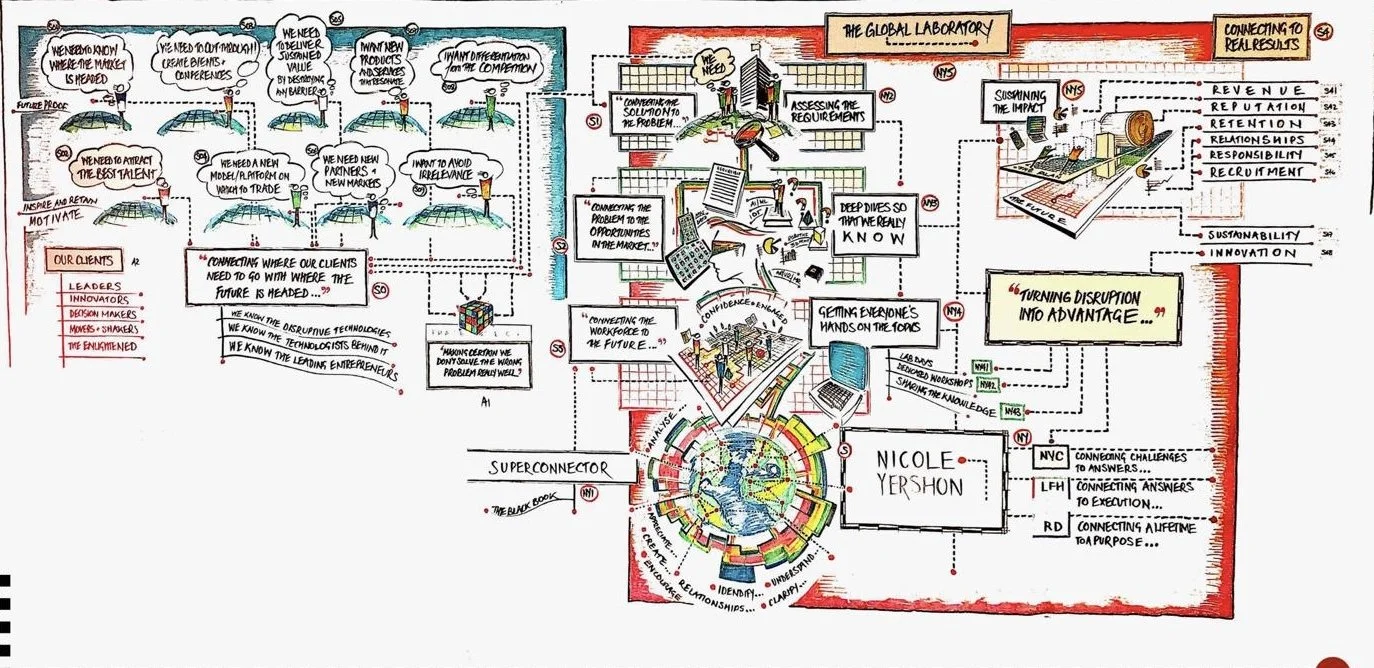
I recently came across a photograph of a wall-sized visualisation that the talented John Caswell from Group Partners created almost ten years ago. Looking at it now, I'm struck by how much of it still feels relevant, and how much of what eventually became The NY Collective was already hiding in plain sight. (btw, the NY is me, Nicole Yershon… and no, I don’t live in NYC)
The drawing was created shortly after the Ogilvy Innovation Lab closed. One day, we were helping organisations understand emerging technologies, entrepreneurs and changing consumer behaviours; the next, we were all out of a job. One of those Excel spreadsheet CEO’s, thinking it was ‘everyone’s job to be innovative.’ She left 3 months later!
At the time, I assumed finding another role would be relatively straightforward. I’m a natural ‘intrapreneur’, and Innovation was becoming a fashionable corporate ambition. Therefore, I found myself invited to numerous interviews for senior innovation positions. The reaction was usually enthusiastic until we got into the details of what innovation actually meant.
Companies loved the idea of innovation. They loved the title. They loved being seen as innovative.
What they didn't necessarily love was the reality.
Innovation requires organisations to rethink how they work, with whom they work, how decisions are made, and where value is created. It often means questioning established business models, inviting uncertainty into the room and experimenting without guarantees. More than once, I found myself explaining what would need to change, only to watch the excitement evaporate.
"Oh," they would say, "that's not really what we're looking for."
It was an important lesson. Businesses frequently say they want innovation, but many are really looking to tick that box, or it’s optimisation. They want the benefits of change without the disruption or time it takes.
After enough of those conversations, it became clear that I wasn't going to find the role I had in mind. In many respects, I had become unemployable. The work I wanted to do didn't fit neatly inside existing structures.
So I created my own.
The NY Collective emerged almost immediately, built around a belief that had been developing throughout my time at the Lab: organisations don't need more information, they need more confidence.
Looking back at the wall, that idea appears repeatedly.
The starting point sits in the top left corner:
"We need to know where the market is headed."
Everything else follows from that observation. The notes scattered across the page describe concerns that remain familiar today: attracting talent, finding new sources of growth, building meaningful differentiation, developing new products and services, creating partnerships, exploring new business models and, perhaps most importantly, avoiding irrelevance.
What interested me then, and still interests me now, was not the individual challenges but the common thread running through them. Every organisation was trying to navigate increasing uncertainty.
At the centre of the drawing is a sentence that became the foundation of my work:
"Connecting where our clients need to go with where the future is headed."
Most advisors position themselves as experts with answers. I was far more interested in helping organisations navigate. The value wasn't simply knowing about emerging technologies; it was understanding the people behind them, the entrepreneurs building them and the wider shifts they represented.
Many businesses are incredibly efficient at solving problems. Fewer spend enough time making sure they're solving the right one. I've always believed that defining the problem correctly is often more valuable than rushing towards a solution. Executing the solution is easy for us, or one of the Collective companies we often use, called Stark Global Events.
The right-hand side of the wall outlines what I called the Global Laboratory. It wasn't conceived as a physical space so much as a system for connecting ideas, industries, technologies and people. The process began by linking business challenges to opportunities emerging elsewhere in the market, followed by deep research, exploration and practical experimentation. The objective wasn't simply to share knowledge but to give people direct experience through workshops, lab days and hands-on engagement.
What stands out most now is the phrase sitting at the centre of the model: Confidence Engine.
Not an innovation engine. Not a technology engine. A confidence engine.
That was always the real product.
The purpose wasn't to help organisations become more technological. It was to help leaders make better decisions in uncertain environments. Technology, research, relationships and creativity were all inputs. Confidence was the output. Only after that would the commercial outcomes: revenue, reputation, retention, recruitment, relationships and long-term relevance emerge.
At the heart of the entire framework was a simple belief: disruption is neither good nor bad. It is simply a fact of modern business. The question is whether you experience it as a threat or use it as an advantage.
Looking back from 2026, I find it interesting that the rise of AI has made this proposition even more relevant than it was when John first put my thoughts and experiences through ‘Structured Visual Thinking’ on a wall. Organisations today have access to more information, more tools and more forecasts than ever before. What remains scarce is clarity. The challenge isn't knowing everything. It's knowing what matters.
The ‘Wall’ wasn't ever about technology. It was about helping people move forward when the future feels uncertain. It was also about the execution of an idea.
And if there's one thing I've learned over the past decade, it's that the organisations that succeed aren't necessarily the ones that predict the future most accurately. They're the ones who develop enough confidence to act before everyone else does.
And where are we now… From strategy to execution: the missing piece
Over the last 10 years, The NY Collective often works alongside https://www.grouppartners.online. There was a recurring pattern. Clients invest time and energy developing a strategy, often using ‘Structured Visual Thinking’ to create clarity, alignment, and a shared direction. Then comes the inevitable question: ‘This is great. Now, how do we actually make it happen?’ - Not because they lack ambition. But because they don't know the right people, companies, specialists, or emerging technologies needed to execute on the strategy. That's where The NY Collective comes in. Rather than operating as a traditional agency, we act more like the conductor of an orchestra or a ‘convenor’.
We help identify and bring together the right people, subject matter experts, and partners to solve the problem at hand. Clients retain us for our network, judgment, and ability to connect the right people to the right challenge. They contract directly with suppliers, creating transparency, removing mark-ups and avoiding the usual layers of interpretation and "Chinese whispers" that often slow projects down.
Over time, relationships become embedded, capability grows, and ideally, we're no longer needed. The client is connected directly to the people helping them succeed. Perhaps the future isn't about building bigger agencies. Perhaps it's about building better-connected ecosystems. This is how the Collective works and needs the ‘super connector’ to work on any problem and find the right solution. Agencies quite often solve the wrong problem really well, as their business model is aligned with ‘you need an ad’ - when perhaps it’s the obvious issue is with the client’s Sales team or Manufacturing. Because the strategy is so tight, it means we only work on what needs fixing.
I wonder where we will be in 2036…
